(206) 707-5830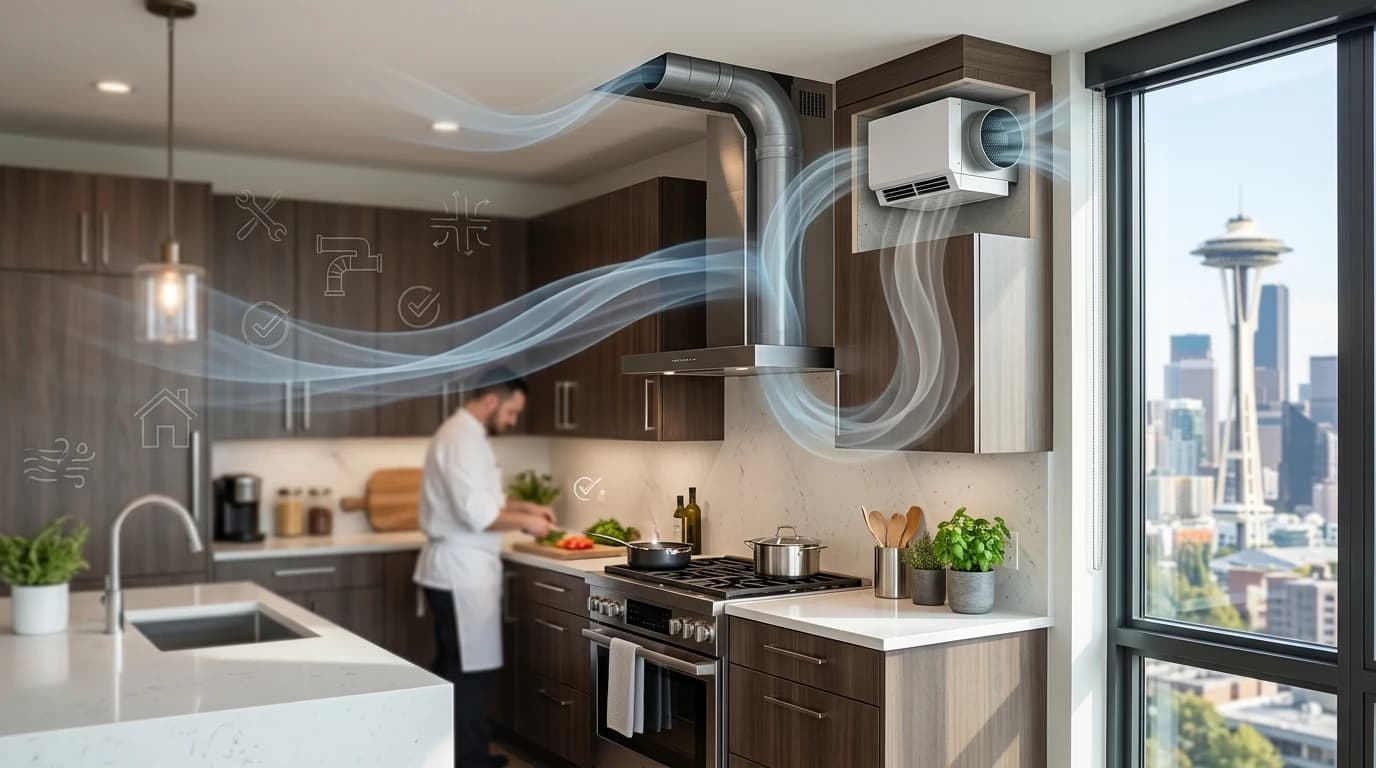

Remodeling a kitchen in a Seattle condo presents a unique set of challenges that differ significantly from single-family home projects. Moisture from our rainy climate penetrates shared walls, condensation builds up in tight spaces, and ventilation systems must work harder to manage humidity that can damage neighboring units. Beyond the weather, you'll navigate HOA restrictions that often limit ductwork routing, exterior vent placement, and noise levels—constraints that simply don't exist in detached homes. These factors make ventilation design not just a comfort issue, but a structural and legal one that requires careful planning from the start.
Quick Answer:
Seattle condo kitchens can use ducted range hoods vented through exterior walls or rooflines, ductless recirculating hoods with charcoal filters, or demand-controlled ventilation systems that work within shared wall restrictions. Most modern condos require HOA approval before installation, and many building codes now mandate makeup air systems to prevent negative pressure issues in sealed units.
This guide walks you through the specific ventilation challenges that affect a condo kitchen remodel in Seattle, explores approved solutions that satisfy both building codes and HOA requirements, and shows you how to integrate ventilation planning into your overall remodel timeline. You'll also learn how ventilation decisions impact your kitchen layout, noise levels, and long-term maintenance costs—so you can make informed choices before construction begins. Understanding these upfront will help you avoid costly rework and ensure your new kitchen performs well for years to come. For a broader view of Seattle condo kitchen remodeling, check out our complete planning guide that covers permits, design, and contractor coordination.
Table of Contents
- Understanding Ventilation Requirements for Belltown and Downtown Seattle Condos
- Ventilation Options for Small Condo Kitchens in Seattle
- Navigating HOA Approval and Permits for Seattle Condo Kitchen Remodels
- Estimating Costs for Your Condo Kitchen Ventilation Remodel
- Design Tips: Integrating Ventilation Into Your Seattle Condo Kitchen Aesthetic
- Planning Your Seattle Condo Kitchen Ventilation Remodel: Next Steps
Understanding Ventilation Requirements for Belltown and Downtown Seattle Condos
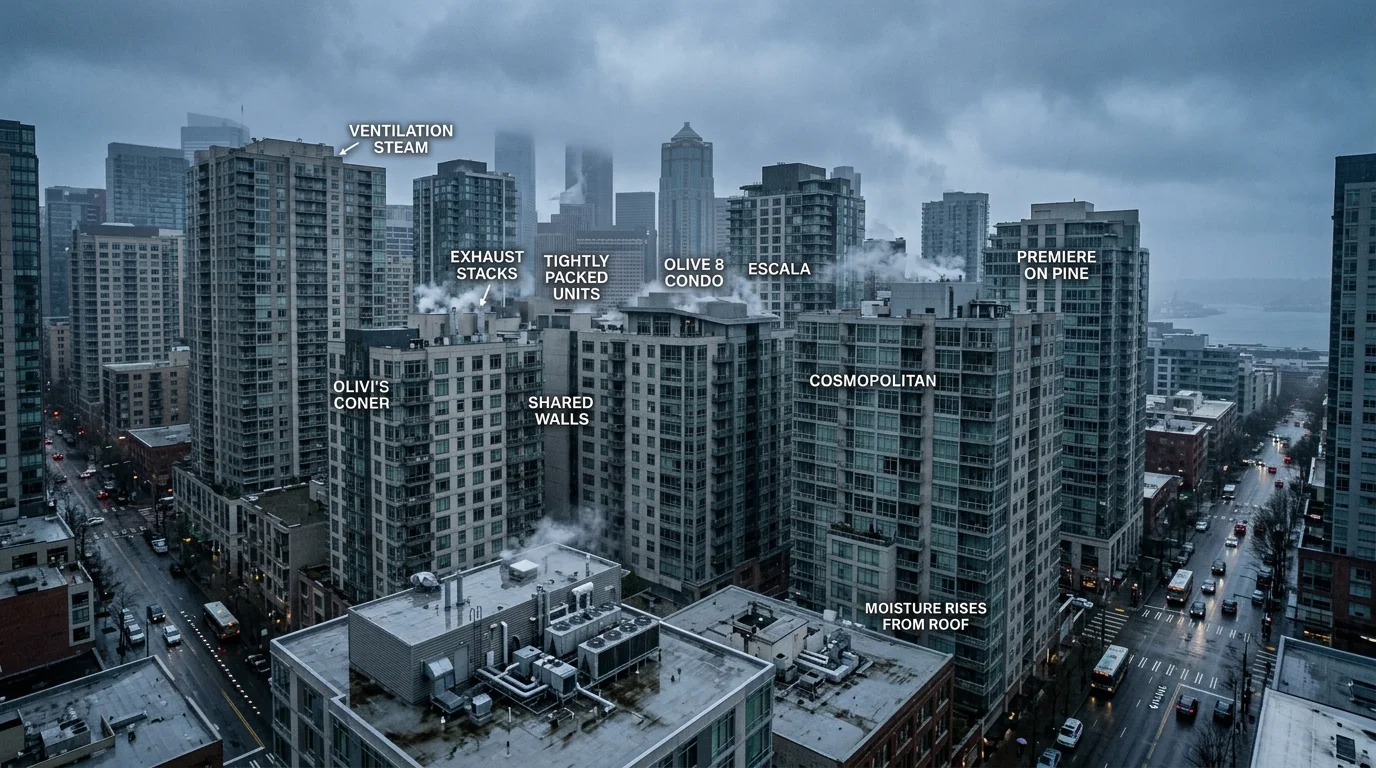
Seattle's maritime climate creates unique ventilation challenges that differ significantly from single-family homes. The region's persistent moisture and high humidity mean that inadequate kitchen ventilation can lead to condensation buildup, mold growth, and structural damage—particularly problematic in tightly sealed condo units where air exchange is already restricted. Unlike houses with attic space and flexible ductwork routing, condos demand ventilation solutions that work within shared walls, limited exterior access, and strict building envelope requirements.
According to the Seattle Mechanical Code 2018, kitchen range hoods or downdraft exhaust fans must provide a minimum of 100 CFM (cubic feet per minute) at 0.10 inches water gauge for local ventilation in residential units. This baseline applies to all condos, but the real complexity emerges when your exhaust system exceeds 400 CFM—at that capacity, makeup air must be supplied at approximately equal rates to prevent negative pressure that can damage building envelopes and compromise HVAC performance.
The permit landscape for condo remodels differs from single-family work. Any ventilation modification affecting the building envelope, load-bearing structures, or exhaust systems requires a permit regardless of project cost. This means even a simple hood replacement typically needs approval from Seattle's Department of Construction & Inspections, plus sign-off from your building's HOA architectural review board. Many Belltown and downtown Seattle condo buildings have specific ventilation policies—some prohibit exterior ductwork entirely, others mandate ductless systems with charcoal filtration, and still others require dedicated makeup air systems.
Before designing your kitchen layout, contact your HOA and obtain a copy of their ventilation guidelines. This step, done early in your remodeling timeline, prevents costly redesigns later. Understanding these requirements upfront ensures your contractor can coordinate permits efficiently and your new kitchen meets both code and community standards.
Ventilation Options for Small Condo Kitchens in Seattle
Seattle condo kitchens demand ventilation solutions that balance effectiveness with spatial constraints and building restrictions. Your choice depends on ductwork availability, HOA policies, kitchen layout, and budget. Here are the four primary options available for small condo kitchen remodels in Seattle.
Ducted Range Hoods
Ducted systems expel cooking vapors directly outside through exterior ductwork, making them the most effective ventilation method. According to KitchenAid, ducted range hoods completely remove contaminated air rather than recirculating it back into your kitchen. In Belltown and downtown Seattle condos, this option works best when your unit sits near an exterior wall or when the building's mechanical chase allows vertical ducting. The main disadvantage: installation complexity and cost. Routing ductwork through shared walls requires HOA approval and careful coordination with building infrastructure. Many older Seattle condo buildings prohibit exterior ductwork on facades, eliminating this option entirely.
Ductless Range Hoods
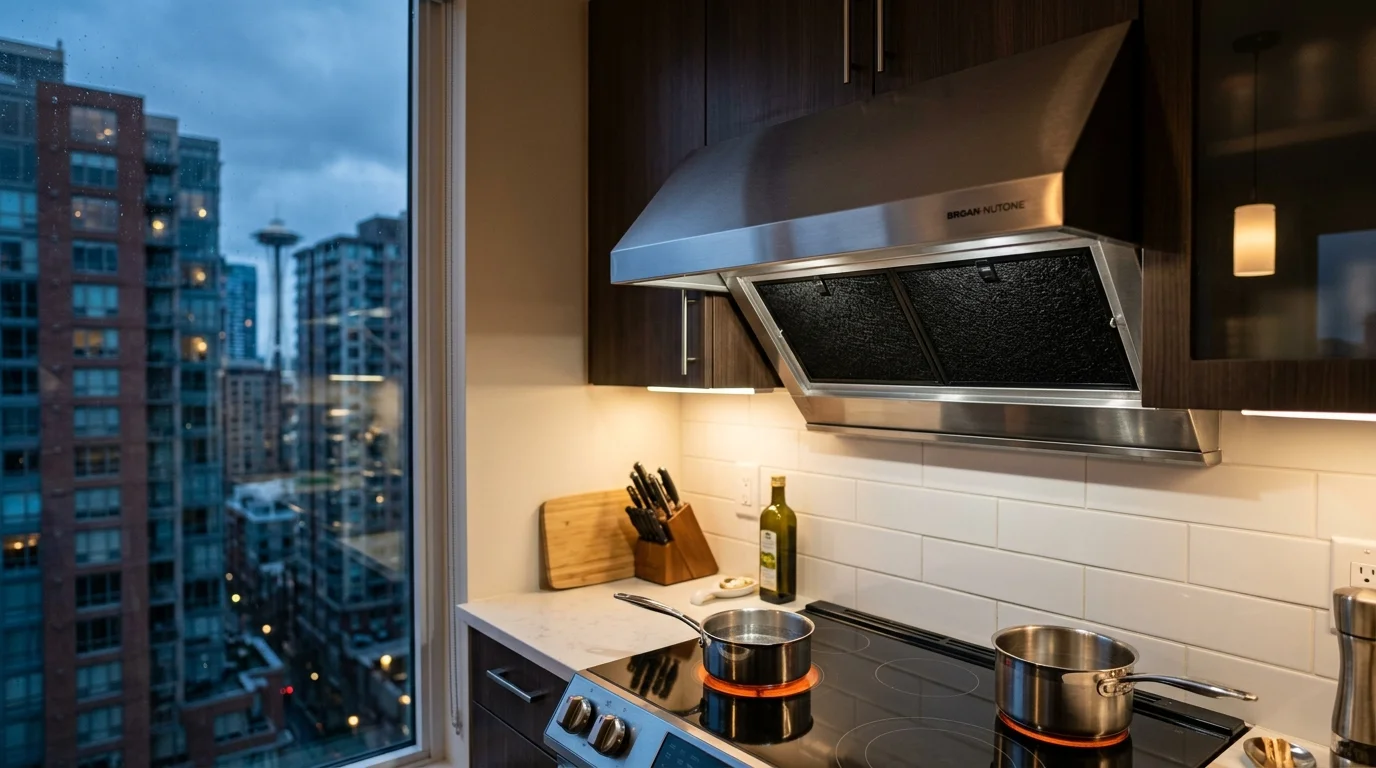
These self-contained units filter air through charcoal and aluminum mesh, then recirculate it back into the kitchen. They're ideal for condos where ducting isn't feasible—no exterior penetrations, no HOA friction, and straightforward installation. The trade-off is maintenance and performance. Charcoal filters require replacement every three to six months to remain effective, and ductless systems inherently capture fewer cooking odors and fumes than ducted alternatives. For small condo kitchens where space is already tight, ductless hoods offer a practical compromise.
Downdraft Ventilation
Downdraft systems pull air downward through a countertop or cooktop-mounted duct, then expel it through the floor or exterior wall. They preserve sightlines and work well in open-concept small condo layouts. However, downdraft systems are less efficient than overhead hoods because rising heat and steam naturally move upward, fighting the downward pull. They also require floor-level ductwork, which complicates installation in condos with concrete slabs or shared mechanical spaces.
Makeup Air Systems
If your hood exceeds 400 CFM, building code requires makeup air—fresh air supplied to replace what the hood expels. Dedicated makeup air systems prevent negative pressure that can damage your condo's envelope and strain HVAC systems. These are typically the most expensive option and require separate ductwork and controls, but they're essential for high-capacity hoods in sealed condo buildings.
| Option | Best For | Key Limitation |
|---|---|---|
| Ducted | Maximum performance, exterior wall access | Requires HOA approval, ductwork routing |
| Ductless | No exterior penetrations, easy install | Filter maintenance, lower odor removal |
| Downdraft | Open layouts, sightline preservation | Less efficient, floor-level ductwork needed |
| Makeup Air | High-CFM hoods (400+) | Additional cost, requires separate system |
When planning your condo kitchen remodel, consult your HOA guidelines early and discuss these options with your contractor. Understanding which solutions your building permits prevents expensive redesigns mid-project and ensures your new kitchen meets both code and community standards.
Navigating HOA Approval and Permits for Seattle Condo Kitchen Remodels
Getting your ventilation system approved in a Seattle condo requires navigating two parallel processes: HOA architectural review and city permitting. These aren't optional steps—they're gatekeepers that determine whether your kitchen remodel moves forward or stalls mid-project.
Start with your HOA documentation early. Most Seattle condo associations require detailed architectural plans before any work begins. You'll need drawings showing your hood type, ductwork routing, exterior penetrations (if applicable), and how the system integrates with existing building infrastructure. Your contractor should provide these; if they hesitate, that's a red flag. According to Pear Tree Homes' research on HOA approval timelines, the review process typically takes 30 to 60 days from submission to decision, though complexity and contractor verification can extend this significantly. Submit everything at once rather than piecemeal—resubmissions add weeks to your timeline.
Common approval obstacles center on three issues: exterior wall penetrations (many buildings restrict these), noise concerns from ducted hoods, and makeup air system requirements. If your building prohibits exterior venting, you're limited to ductless or downdraft options. Bring your HOA's architectural guidelines to your initial contractor consultation—this prevents designing a system that won't pass review.
Once HOA approval is secured, obtain your mechanical permit from the City of Seattle. Mechanical permits for range hood installations cost between $100 and $230, with potential additional fees for fire-safety inspections. Seattle issues Subject-to-Field-Inspection (STFI) permits the same day for straightforward kitchen projects that don't require extensive plan review, meaning you could have your permit in hand within 24 hours. More complex installations involving makeup air systems or structural modifications take longer.
Work with your contractor to coordinate timing. They should handle permit applications and HOA submissions—this is standard practice and protects you from costly mistakes. If you're managing the project yourself, submit HOA documents first, secure approval in writing, then file for permits. Never start work before both approvals are finalized; violations can result in fines and forced removal of non-compliant systems.
PNW Standard Remodel manages this process routinely across Seattle's diverse condo buildings. We maintain relationships with major HOAs, understand local code nuances, and build timelines that account for both approvals. This expertise prevents the redesigns and delays that plague DIY approaches.
Estimating Costs for Your Condo Kitchen Ventilation Remodel
Ventilation costs in Seattle condos typically range from $564 to $3,000+ depending on the system type and installation complexity. According to Homewyse, basic under-cabinet range hoods run $564–$1,030 installed, while downdraft systems and island hoods jump to $1,500–$3,000 for materials and labor combined. These figures assume straightforward installations without structural modifications or makeup air systems—common in condo projects where ductwork already exists.

| Cost Component | Budget Range | Notes |
|---|---|---|
| Under-cabinet hood (material + labor) | $564–$1,030 | Most common condo option |
| Downdraft/island hood | $1,500–$3,000 | Higher complexity, custom ducting |
| Permits (STFI) | $100–$230 | City of Seattle mechanical permit |
| HOA review & approval | $0–$500 | Some buildings charge review fees |
| Makeup air system (if required) | $800–$2,000 | Adds cost but improves performance |
Condo kitchen remodels cost more than single-family homes because of HOA coordination, stricter code compliance, and shared ductwork constraints. A typical condo kitchen remodel in Seattle ranges $25,000–$75,000 for mid-range projects, with ventilation representing 3–8% of total spend. For comparison, condo bathroom remodels in Seattle run $8,000–$25,000, meaning ventilation is a smaller piece of the overall kitchen investment puzzle.
Labor dominates the cost equation. Seattle contractors charge $75–$150 per hour for installation, and complex jobs involving ductwork rerouting, makeup air integration, or structural venting can stretch 8–16 hours. Material costs vary: basic stainless steel hoods cost $300–$600, while premium models with smart controls and quiet operation reach $1,200+.
Don't forget permitting and HOA fees—they're easy to underestimate. Seattle's Subject-to-Field-Inspection permits typically cost 1.5–2% of project valuation, meaning a $100,000 kitchen remodel requires roughly $2,000 in permit fees. Some HOAs add $200–$500 for architectural review. These administrative costs aren't glamorous, but they're non-negotiable and prevent costly rework later.
Work with your contractor to get a detailed estimate that breaks down labor, materials, permits, and contingency (typically 10–15%). This transparency prevents surprises and ensures your budget aligns with Seattle's real-world condo remodeling costs.
Design Tips: Integrating Ventilation Into Your Seattle Condo Kitchen Aesthetic
Ventilation doesn't have to be an eyesore. In fact, the hood you choose becomes a focal point in your Seattle condo kitchen—it's one of the first things visitors notice. The key is treating it as a design element rather than an afterthought.
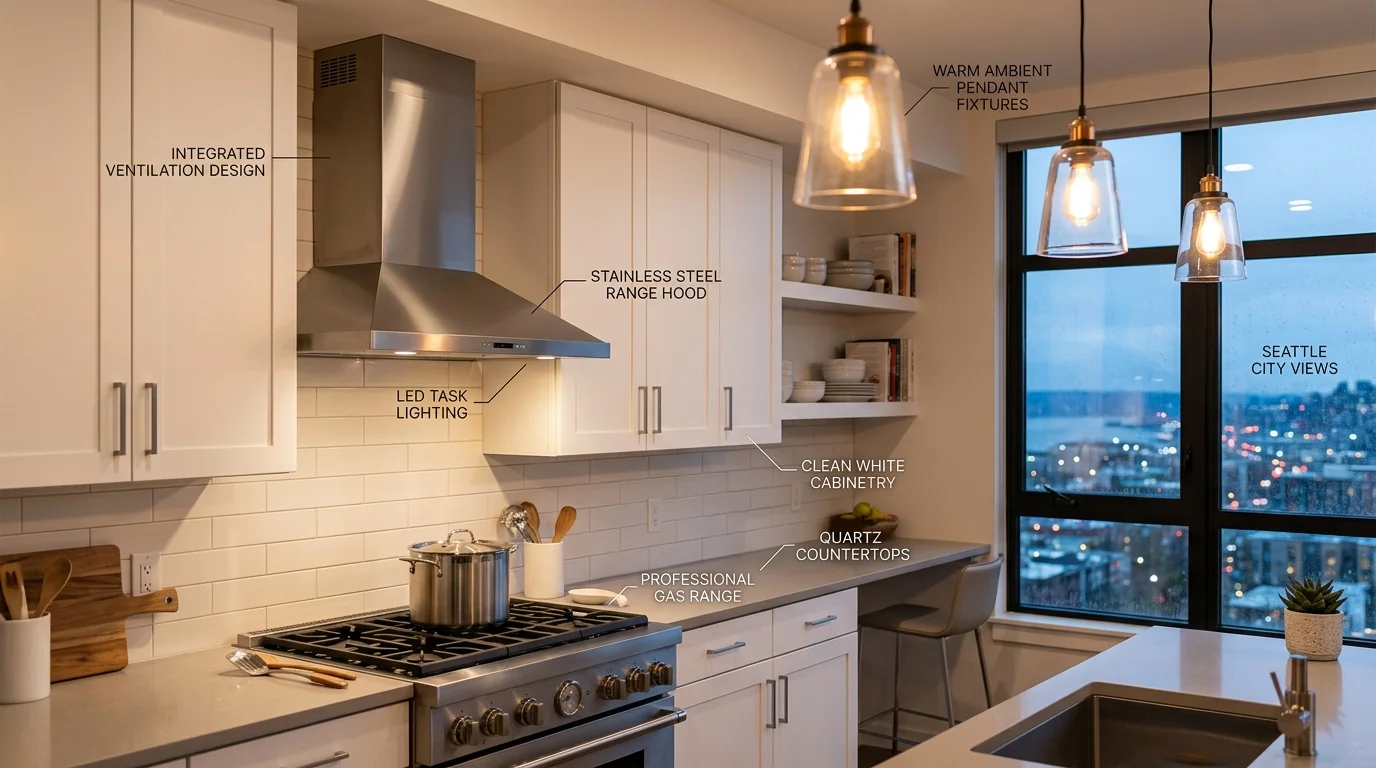
Hood style matters more than you'd think. Sleek stainless steel hoods complement modern minimalist kitchens common in Belltown and downtown Seattle condos. If your aesthetic leans transitional or farmhouse, consider a custom wood-wrapped hood that matches your cabinetry, or a decorative range hood with integrated lighting that doubles as ambient task lighting. Island hoods with curved glass or sculptural metal frames can anchor an open-concept layout while keeping sightlines clear in tight spaces.
Color and material coordination prevents visual clutter. Match your hood finish to your appliances and hardware—mixing brushed nickel, matte black, and stainless creates visual chaos in a small footprint. Alternatively, go bold: a matte black hood against light cabinetry creates sophisticated contrast that feels intentional, not cramped.
Ductwork routing is where design meets function. Conceal ducts behind soffits or cabinet bulkheads whenever possible. If external venting is unavoidable, run it along a wall edge rather than the kitchen's visual center. When working with your contractor on cabinet options for small kitchens in Seattle, coordinate ductwork placement simultaneously—retrofitting later costs significantly more.
Quiet operation enhances the experience. Premium hoods with sound dampening ($1,200+) feel less intrusive in open-plan condos. The aesthetic of a beautiful hood diminishes if it sounds like a jet engine. Invest in variable-speed fans that adjust to cooking intensity rather than running at full blast constantly.
Planning Your Seattle Condo Kitchen Ventilation Remodel: Next Steps
Your ventilation choice shapes the entire kitchen experience—from air quality to noise levels to visual aesthetics. By now, you understand that Seattle condo kitchens demand solutions balancing effectiveness with spatial constraints and HOA compliance. The path forward requires three parallel decisions: selecting the right system type for your space, securing HOA approval, and budgeting realistically for installation.
Start by scheduling a consultation with a contractor familiar with Seattle's specific condo requirements. PNW Standard Remodel brings deep expertise in navigating both building codes and HOA architectural review boards across downtown Seattle, Belltown, and surrounding neighborhoods. During your initial estimate, discuss your kitchen's existing ductwork, your building's venting infrastructure, and your HOA's specific restrictions. This conversation clarifies whether you're looking at a $564 recirculating hood or a $3,000+ ducted system—and what approvals each path requires.
Before committing to any system, request your HOA's architectural guidelines in writing. Many buildings require pre-approval drawings showing hood placement, ductwork routing, and exterior termination points. Parallel to this, pull your building's permit history through the City of Seattle to understand what ventilation systems have been approved previously in your building. This historical context often accelerates your own approval.
Budget for both the equipment and installation complexity. Factor in potential ductwork modifications, soffit work, or cabinet adjustments. When coordinating with your contractor on kitchen remodel timelines, include ventilation planning from day one—retrofitting later multiplies costs and delays.
Ready to move forward? Contact PNW Standard Remodel for your free estimate. We'll assess your condo's unique constraints, guide you through HOA approval, and deliver a ventilation solution that works as beautifully as it performs.